→ groozi [sales + web]

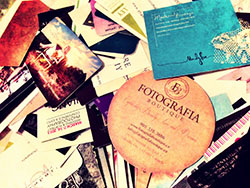
If you are going to take the time to develop a networking strategy, one of the first items you’ll need is a drop-dead gorgeous business card. I mean a card that when you hand it to someone, they say, “Wow, that’s a really nice business card.” If you’re not getting this response, you need a new business card.

First, photographers are not designers. Hire a designer to do your card. If money is tight, maybe you could trade services with a designer. They know what’s current as far as design styles go, understand and are aware of papers, and will help you to create a better looking card that you probably could.

Read more » » »

1 Comment

handshakeI presented my program “Stop Grumbling – Get Out There” to a group photographers in New Orleans. (The New Orleans chapter of the American Society of Media Photographers.) It’s a roughly two hour seminar on networking and negotiating techniques.

Usually the doors open about an hour before I speak and I use that time to introduce myself to people as they arrive, exchange business cards, and to get a rough gauge of where the audience is in terms of networking experience. I always ask the question, “So tell me about what you do,” and from a person’s response I can tell a lot about what stage of their career they’re in and how much experience they have in handling a first-time face-to-face meeting with a stranger.

Read more » » »

1 Comment

When designing a new website (or redesigning your existing one), one of the first decisions you’ll have to make is what to call your portfolio galleries and what to include in your images. Photographers are all over the map, some simply number their galleries: Gallery 1, Gallery 2, and so on. Some use more descriptive words: People, Places, Editorial, and Corporate. I’ve even seen gallery titles such as, Happy Faces, Beautiful, and Innocent. Clients I’ve asked prefer intuitive, descriptive gallery titles.

I think even more important than gallery names is that you include personal work. Years ago, before the web became the prominent method of showing one’s portfolio, a consultant suggested that in addition to one’s regular portfolio, a photographer should have a second, perhaps smaller, book of personal work.

Read more » » »

1 Comment

At 4:51am Sunday the server on which this blog is hosted was suffered a “defacement attack by a hacker, at least that’s what my hosting company called it. I’d never heard of such a thing, but they call it that when only the homepage of a site is altered and no other destructive scripts or malware are planted. The hacker changed out the index.php page in every directory of this WordPress blog. (A screengrab of his idea of what Groozi should look like is at the end of this post.)

I remained calm, figured out a fix, located a clean copy of index.php from WordPress, replaced the hacked one with the good one, and was back in business.

After hunting around, I found a great plug in for WordPress called “Backup to Dropbox” (full info). The easiest way to install the plugin is to search for it within your Admin/Plugins panel of WordPress and install it from there, but you’ll need a free Dropbox account first.

If you are unfamiliar with Dropbox, it is “cloud” hard drive storage. When you sign up, you get 2GB of free storage and that’s where the plugin will automatically store a complete backup of your blog. You can even schedule backups. If you don’t have Dropbox, get it here. Full disclosure: If you use that link to sign up, you and I will both get an extra 256MB of storage, so we both win… cool! UPDATE (4-10-12): Now we’ll each get 500MB of free space!

Now I’ll have a recent backup of my entire blog including all my posts and images and I don’t have to remember to do it, the plugin does it for me. Here’s what the hacker’s handiwork looked like:

.

4 Comments

Most emerging photographers consider themselves generalists if for no other reason than that they want to work and any paying job coming their way sounds like a good one. But if this is where you’re at in your career, you’ll need to at some point do two things: first, become more of a specialist and second, be willing to let go of those early, low-paying clients. In this essay I’ll talk about the low-paying clients.

Let’s imagine the owner of the muffler shop on the corner of Main Street calls you to shoot some pictures of his shop for an ad he is running in the local weekly newspaper. We’ll call him Joe. He’s only willing to pay a small fee and you’ve done all you can to show him your value, why you’re better than everyone else, and most important, you’re convinced you’ve negotiated as far as you can with him on price. You do the shoot, he’s very satisfied, and he wants you to do more work. The fact remains though, he’s a low budget client.

I’m convinced there are two ways to make more money in any service business, including photography: work more or get better clients. I’ve taken the road of working to get better clients. More sophisticated clients understand copyright, understand licensing, and are in general much easier to work with. They are used to working with professionals in every aspect of their business.

Joe on the other hand sells a muffler and his customer owns it. Forever. The very concept of copyright is possibly foreign to him. He thinks since he’s paid you to take the photograph, he owns it. Licensing? That’s at the Department of Motor Vehicles!

As you begin to gain better clients, don’t be afraid to let go of Joe… ask me how I know. What happened to me will happen to you, guaranteed. You’ll have a day booked with low-paying Joe, and that great client you’ve been after for some time now, calls you asking you to shoot that very same day.

Don’t let Joe hold you back. At some point it’s no longer worth it to work for him. Instead, use that time working on your website, your physical portfolio, your other marketing efforts, tweaking your LinkedIn profile, or making a few phone calls or sending samples to prospective clients.

To move forward, you need to let go of whatever it is that’s holding you back. Even if it’s a client. The one exception, at least for me, is the low-paying client who is a rich referral source. To this day, I have one client who, even though I’ve not raised my rates for over ten years, consistently gives me quality referrals. She knows to keep my ten-year-old pricing “our little secret” and in fact pre-sells me as “one of the more expensive photographers in town, but definitely the best!”

I’ll be presenting my sales and networking program “No More Grumbling – Get Out There” in Dallas tonight, September 22nd, and in New Orleans on Tuesday, September 27th.

5 Comments

Susan Carr is the Education Director of ASMP, the American Society of Media Photographers. Her latest book, The Art and Business of Photography, has received critical praise from both photographers and scholars for its candid look at the changing photography industry. It’s quickly become required reading in many university photography curriculums and I consider it an essential read for both emerging and established photographers.

Susan spoke yesterday to a standing-room only crowd at B&H in New York and answered questions from the audience. If you want to purchase a copy for yourself, it’s available at Amazon. I have it on my Kindle and I refer to it frequently. Her publisher, Allworth Press, has graciously permitted me to publish an excerpt from the book. I’ve chosen a few paragraphs from chapter four, “Where Are the Clients?”

- – -

Chris Anderson’s controversial book Free: The Future of a Radical Price created quite a buzz in the professional photographic community when it was released in 2009. The gut reaction by many photographers was negativesurmising that Anderson was pitting free against paid to the detriment of the professional in any field. Anderson actually does a masterful job of outlining a history of how businesses have used the “free economy” to build products and services people will pay for. Anderson writes, “The way to compete with Free is to move past the abundance to find the adjacent scarcity. If software is free, sell support. If phone calls are free, sell distant labor and talent that can be reached by those free calls (the Indian outsourcing model in a nutshell). If your skills are being turned into a commodity that can be done by software (hello, travel agents, stockbrokers, and realtors), then move upstream to more complicated problems that still require the human touch. Not only can you compete with free in that instance, but the people who need these custom solutions are often the ones most willing to pay highly for them.”

Like it or not, the photographs licensed every day and, in many cases, even the service of photography are now commodities. Generic photographic subject matter will no longer produce substantial financial rewards nor will it be possible to build a career taking corporate headshots. I return to [Seth] Godin who always seems to concisely hit the nail on the head. “Your organization is based on exploiting scarcity. Create and sell something scarce and you can earn a profit. But when scarce things become common, and common things become scarce, you need to alter what you do all day.” Godin further offers that spare time, trust, and attention are things that used to be abundant and are now scarce. Remember these when formulating your business strategy; potential clients do not have extra time, have trouble giving things attention, and are skeptical as a default. Turn those challenges into assets by saving clients time, being easy to do business with and building trust through quality and professionalism.

Photographs in general are definitely not scarce. We cannot compete on price when seemingly endless images are available for free or nearly free. We cannot compete with mediocre imagery when there are loads of one-click options for obtaining mediocre photographs. Photographers must define what they can bring to the table that is rare and that brings us back to creativity. A specific vision, style, or point of view directed towards a particular passion or interest is our one true unique offering. As a photographer, you need to develop a vision in your imagery, but that same creative thinking needs to be applied to how you run your business. Make it a package, so that all components speak to the same
core message of genuine quality and value.

6 Comments

DiscountA question was asked on one of the photographer forums I read regularly:

“I recently convinced a magazine client to commission assignment photography as opposed to buying rights managed. Thus far, we have come to an understanding of fees for the assignment but they have come back asking for the rights to run the story in two other publications that they operate. These are major international publications — UK, China, Asia Pacific markets. I would very much like to keep this client and to increase my relationship with them. What would be the best approach to negotiating for the additional rights? Any insights are much appreciated.”

All sorts of suggestions were being tossed into the conversation, most of them suggesting offering a discount in the form of a percentage of the original fee, for example 25-percent of the original fee.

Creative/marketing consultant and attorney Leslie Burns, offered this excellent advice:

“First, think about it… if the original publication would be seen by (hypothetically) 10,000 people and is worth $X license fee (that is, ONLY the license fee, and not your creative fee for making the image), then a second publication which reaches 10,000 people would also be worth $X license fee. Same reach/effect = same value. Then, because they are being good clients and/or wanting multiple licenses, you can cut them a deal. Give am a discount for multiple licenses. This could be whatever you want it to be — hypothetically, you could say ‘one additional pub with 10,000 circulation = 15% discount; two additional pubs, each with 10,000 circulation = 25% discount per pub.’ Really, it’s what you can negotiate. But a low number like 25% of the original fee for such significant additional use is de-valuing your work. Always look to the actual value of the work as if it were an entirely new license first, then decide if you want to discount that fee as a bulk license or good client kind of benefit.”

I think Leslie makes a good point. I consider a 20-percent discount from any of my favorite places to shop a great deal. Think in terms of discount from the original fee instead of a percentage of the original fee. A subtle semantics change, but an important one.

Have a look at Leslie’s blog, Burns Auto Parts Super Premium Blog. She also has a brand new iPhone app: “Burns Auto Parts Consultants To Go” which is pretty slick. (She’s not in the auto parts business, honest!)

2 Comments

Denver Photographer Don CudneyIt’s time for another guest post and we’re fortunate to have an excellent article by Denver Photographer Don Cudney. In it Don shares his thoughts about how experience effects pricing. Don is a member of the American Society of Media Photographers (ASMP). That’s him there on the left shooting HDSLR video on a chilly night.

When it comes to bidding on a job your level of experience should mean nothing if you are just as capable of pulling off a shoot as your competitors. Seriously. Has a client ever asked you to bid less because of your lack of experience? If they did they’re cheap and not a good fit for your business.

I recently took two fellow photographers to lunch. One has been shooting for over twenty years, the other just under two years.  Days before our lunch both photographers were called and bid on the same large assignment.

The inexperienced photographer thought, “Alright, I should bid less because I have less experience.” The experienced photographer thought, “I should bid less because the other guy is going to bid less because of his lack of overhead.”

Now here’s the irony: only the photographers were having this dilemma. The client had no idea how long either of them had been in business — he was simply looking to hire a photographer, one or the other.

Remember, only you know of your inexperience — the client called you. Remember when you make your bid that they did not call me or someone else, they called you! I’ve spent 20+ years bidding against photographers with a lot more talent and experience than I had in some cases.

Photo ©2011 Bryce Boyer

5 Comments