Does Your Business Card Suck? Five Valuable Tips!
 First, my research, with apologies to “Harper’s Index”. I collected business cards for door-prize drawings at a recent speaking engagement, “Sales for People Who Hate Selling Selling” in Las Vegas.
First, my research, with apologies to “Harper’s Index”. I collected business cards for door-prize drawings at a recent speaking engagement, “Sales for People Who Hate Selling Selling” in Las Vegas.
 Photographers are not the best editors of their own work. The task of choosing which images belong in your portfolio, either online or analog, is often best left to anyone but yourself.

©Rick McCleary, used with permission
Your post has been stuck in my head for a couple days because it makes me recall the exact same sentiments I felt when I was starting out – all full of myself and feeling like the world owed me something/everything. There are a couple things you need to embrace that will help you get out
of your own way:
1) This is a business, just like any other business. Nothing is given. Learn the basics. Read some business books that stress marketing. Read Seth Godin’s blog.
2) No one owes you anything.
3) Your job is to make your client’s life better. See the world from your client’s perspective. User experience, and all that.
Q: So, let me see if I got this straight: I have to be “persistent”?
RM: Yes, exactly.
A small chain of outdoor adventure clothing shops based in Ann Arbor, Michigan sends me emails from time to time since I am a regular customer. Today’s email was a holiday promotion but what caught my eye was a link titled, “Gifts for Ex-Lovers”.
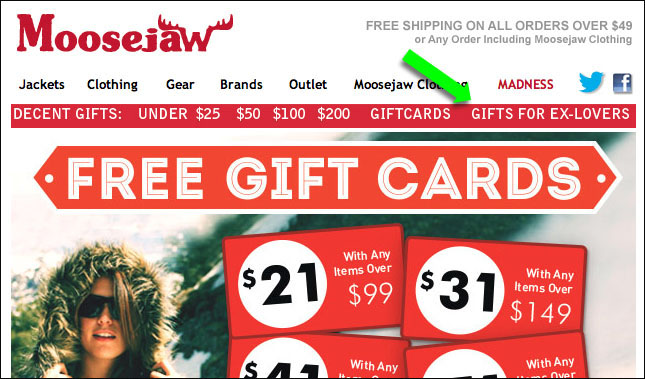
Like everyone, I have ex-lovers so my curiosity got me and I wanted to see what the gang at Moosejaw would suggest I give an ex. If you’re unfamiliar with the psyche of the company, one day this past summer, they were bored, took a hunk of bologna and a deli meat slicer up to the roof of their headquarters and whipped sliced bologna at passing cars and made a video of the fun! (click here, opens in new window). Suffice it to say, they’re an irreverent bunch… one reason for their success in their target demographic I’m sure.
 I clicked the link and was sent to a page of the site containing 16 items that I guess they deemed appropriate for ex-lover, most of which I’d be grateful if an ex-lover sent me. A few stood out from the rest (and I’m keeping my comments to myself): a “Ruffwear Roamer Leash”, a “Black Diamond Pecker” (that’s it to the right), a “SOG Flash I Knife”, and a “Back Country Access B1 Shovel”. Hmmmmm.
In any case, I’m guessing that link in the email will get the most click-throughs of any. Think outside the box, be different, and be successful!
.
 Zig Ziglar passed from this world today after a short bout with pneumonia. He made a huge impact on me in my early sales and networking training. I bought cassette tapes, audio CD’s, and VHS videotapes and worked hard to absorb everything he threw at me. His style was approachable, his name memorable, and his wisdom unmatched. He is the one person I can credit with making me feel comfortable in front of audiences as I speak on the same topics to industry trade groups. I admonish my audiences: “Buy and put to use anything you can get your hands on by Zig.”
Thanks for everything Mr. Ziglar, you’ve helped me along the way many times.
Here are a few of his pearls of wisdom:
“Where you start is not nearly as important as where you finish.”
“I Honestly believe I have felt your feelings. I HAVE WALKED IN YOUR SHOES. You may have made some mistakes and you may not be where you want to be, but that has NOTHING to do with your future.”
“You don’t have to be great to start but you have to START to be great.”
“What you GET by achieving your goals is not near as important as what you BECOME by achieving your goals.”
“You were Designed for accomplishment , engineered for success and endowed with the seeds of greatness.”
“When you THROW DIRT at people, you’re not doing a thing but LOSING GROUND.”
“You are the only one who can use your ability. It’s an awesome responsibility.”
Have any Zig Ziglar thoughts?
.
 This post is an excerpt from my book, “Stop Your Grumbling. Get Out There! (The essential guide to networking to improve your bottom line.)” If you want to get your hands on a copy, it’s available from Amazon in paper or Kindle editions.
If you quit, you’ve failed… so don’t quit!
You remember Mr. Potato Head? The toy was almost dead after its market debut. In the beginning, the toy was given away for free, as a prize in cereal boxes. But it required a real potato – not included, as you might suspect. The toy didn’t gain traction when they introduced just the parts to the marketplace, some think because it required a real potato. Instead of giving up (quitting!), the manufacturer decided to include a plastic body in the kit, Hasbro took over, and the rest is history. If you have kids, you know how important Mr. And Mrs. Potato Head were in rescuing Woody from the toy collector in Toy Story!
Failure is a necessary component of success. I started my sales career selling franchises for American Speedy Printing, a Michigan quick-print franchise. Any professional salesperson knows that sales is nothing more than a numbers game. Most say that out of 20 sales presentations you make, you’ll successfully close, or sell, just one prospect.
Each franchise I sold garnered me a $3,000 commission. I was talking to one of the more successful salesman there and explained I was very frustrated that I was hearing “no” again and again and hadn’t received commission money for some time. He told me I was thinking about sales entirely wrong. Instead of just regarding the close as a success, I had to think of each “no” as a success.
I must have looked puzzled, he went on to explain: the commission is $3,000 and statistically, you know you need to make 20 calls to sell one. And then he changed how I thought about hearing “no.” He said that every time he makes a call, he makes $150, or 1/20th of $3,000! Amazing. It’s just a different way of wrapping your head around failure. Each failure gets you closer to a success, so each failure is indeed worth something!
When you fail, learn from it, figure out what went wrong in your presentation. Perhaps you need to better demonstrate your value to your prospective clients. Perhaps you need to send samples specific to the job they’re calling about. Something in your presentation needs to be tweaked.
 I’m writing a book and find myself leaving my office to write at a local coffee shop where I can be singularly focused on the project. While there this morning, it occurred to me how unappealing their baked goods looked and why. The shop’s competitor is Starbucks, just 4 doors down. I prefer this shop because it has less traffic and is quieter than Starbucks, not to mention they make great coffee!
But I’ve NEVER bought anything out of their pastry case. Why? Because all their offerings are wrapped in plastic-wrap. It looks horrible. My brain thinks anything pastic-wrapped was packaged the day before and was encased in a polyester tomb so they could squeeze an extra day of “freshness” out of it. Not only that, but the frosting or glaze on any pastry is going to stick to the wrapper when I open it… ugh! Starbucks on the other hand presents all of their baked goods unwrapped. They’re fresh. They’re appealing. I buy them.
How are you packaged? Is your website a boring template? Hope not. Does it look fresh? Hope so. Does it have big pictures? It better, potential clients want to see large, in-your face images. Can a viewer fly through 5 or 6 images in 5 seconds? They should, web usability expert Jakob Nielsen (website, opens in new window) says visitors to your website will give you eight seconds (yes eight!) of their attention to locate what they’re looking for.
So ask yourself: How are you “packaged”? Are you a muffin in plastic-wrap? Or are you a baked-fresh, pleasing-to-look-at, delicious, gotta-have-it slice of lemon poppyseed cake?
—
Written by one of many Detroit Photographers, Blake J. Discher. BTW, that sentence was crafted around the phrase “Detroit Photographers” for SEO purposes for my studio’s website. Photograph copyright 2012 Blake J. Discher, it’s mine, please don’t take it without asking first.
Written by People Photographer Blake J. Discher
 ASMP’s hot-off-the-presses book helps photographers understand photo markets in the digital age. “The ASMP Guide to New Markets in Photography”, consists of chapters written by individuals having different areas of expertise including including Tom Kennedy, Peter Krogh, Judy Herrmann, Richard Kelly and Colleen Wainwright. My chapter discusses selling in the new economy, what follows is an excerpt:
Testimonials Are Gold
Testimonials on websites are fast becoming popular. In today’s rushed world however, merely sending an email asking for a testimonial will likely not yield positive results. Your request will likely drop to the bottom of your client’s to-do list. Because of staff cutbacks, most of our clients are doing the work of several people and might not have the time to get to your request.
Make it easy for them. Instead, write the testimonial yourself and then email it to your client with a paragraph letting them know you’ve enjoyed working with them in the past and you’ve attached a testimonial about the photography you provided for their approval. Don’t go overboard in your review of yourself, keep it humble and let them embellish if they care to.
Keep in mind that some corporations forbid vendors from trading on their name. Check any contracts or other written agreements you may have signed before posting any testimonials on your site. Don’t assume your company contact knows the corporate policy.
 groozi.com is a blog about negotiating and web marketing. Weekly posts are written primarily by me, Blake J. Discher, a Detroit people photographer, an SEO
consultant, and speaker. I've presented seminars on SEO and Sales & Negotiating more than 100 times to trade groups of every size around the world. If you are interested in having me speak to your group, detailed overviews of each of my programs are available here.
groozi.com is a blog about negotiating and web marketing. Weekly posts are written primarily by me, Blake J. Discher, a Detroit people photographer, an SEO
consultant, and speaker. I've presented seminars on SEO and Sales & Negotiating more than 100 times to trade groups of every size around the world. If you are interested in having me speak to your group, detailed overviews of each of my programs are available here.
 Networking is the key to getting more clients in order to improve the profitability of your company.